TUNE88
The MANUAL
| Feature | What you get |
|---|---|
| Beat Speeds | Auto-detected intervals, live beat rate, lock and log, ladder step percentages. Fourteen checks from thirds to nineteenths with wide/narrow calls. |
| Honest Readings | QUIET on intervals too gentle to matter; false-beat flags on strings that wobble alone. |
| Pitch Tuning | METER and GRAPH views, every note reading zero at its own solved target, LOCK freeze-frame, optional curve-offset display. |
| Unison Work | Multi-partial strobe: stillness means the unison is done. |
| Measure Piano | Your highest wound string and twelve notes, or the six temperament notes; each note grades green as it banks; spot re-measure any note later. |
| Pitch Raise | Per-note overpull calculated from the measure, read unmuted, one-string overpull option, one or two passes. |
| Stretch Styles | Classic, Mellow and Concert; pure octaves, 12ths, 19ths and double octaves; custom blends solved like the built-ins. |
| Temperaments | Equal and the historical book, solved on your measurement, plus your own custom temperaments. |
| Bearing Sequences | Defebaugh's F to F, Potter, Bill Bremmer's Marpurg, guided step by step with live checks. |
| LISTEN | Isolates the beating partials into your headphones while you tune. |
| Training | Theory pages, a temperament simulator, drills on your own piano, and ear-training levels from ±60% down to ±1.6%. |
| Reports | Client-ready tuning report and quality check, with a temperament score. |
| Tuning Files | Saved per client and instrument with notes, search and progress; reopening a file rebuilds its exact curve. |
| ET Tuner | A plain equal-temperament tuner for when that is all the job needs. |
| Noisy Venues | Always-on noise reduction, tuned for working rooms. |
| Landscape | All 88 keys and the whole bench laid out sideways; tap either window to switch between beats and pitch. |
| Appearance | Light, dark, or follow the system. |
| Privacy | Everything on device. No accounts, no tracking, audio never leaves the phone. |
| Proof | 468 recorded strikes must read identically before every release; the stretch engine is re-checked against 10 real instruments and 300 modelled pianos, and against the master sessions it was derived from. |
Beat Speeds
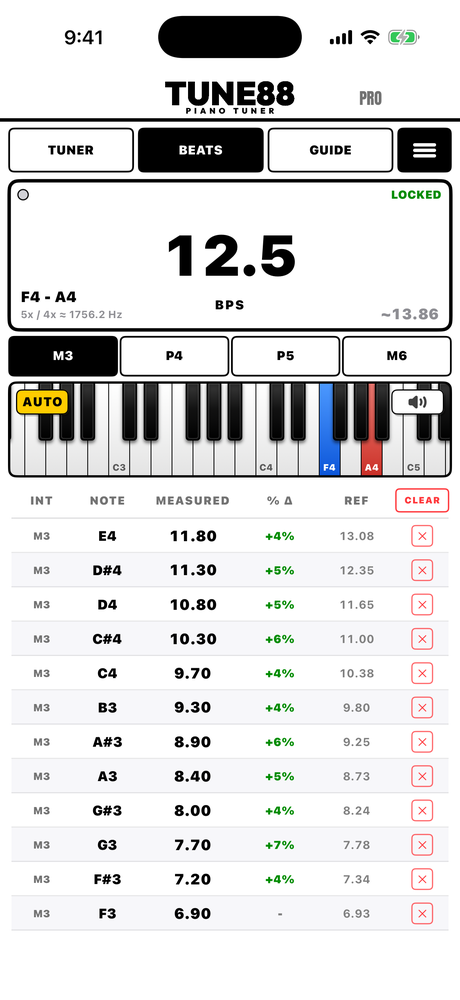
Park on a note and play an interval. The detector listens to the coincident partials of both strings, works out which interval you played, and measures the beat between them. When the reading settles it stamps LOCKED and logs the rate, the step percentage over the interval before it, and the solved reference.
Intervals: thirds, fourths, fifths, sixths, octaves, tenths, twelfths, seventeenths and nineteenths, fourteen checks in all, with wide/narrow readings on the tenths and seventeenths. The pills above the roll choose the family; ACTIVE INTERVALS in the menu chooses which pills show.
Best practice: a clean single strike and a second of ring beats hammering the keys. It reads beat speeds better on muted strings. Two strings sounding where you wanted one puts a second, unrelated beat into the same window, and the detector has to pick between them; a wedge in the unison removes the question. Unmuted still works in the midrange on a piano whose unisons are close, and it is the faster way to work. But if a reading will not settle, mute it before you blame it. In GUIDE mode the detector restricts itself to the current step's interval, so a stray note cannot log a false row.
Pitch Tuning and Unisons
Every note reads zero at its own solved target, so tuning is always the same job: bring the number to nothing. METER is one line against a strobe; the stripes drift sharp-left, flat-right, and stop dead only when you are truly on pitch. GRAPH is the live spectrum: each sounding string is its own peak, the solid line is the target, and the scale magnifies the last few cents where the work happens. TARGET AS CURVE OFFSET in Display shows each note's cents against ET instead of zero-centred, if you prefer the classic view.
LOCK: a struck note is never one pitch. It jumps as the hammer leaves, falls away through the decay, and settles differently again once the string quietens, so a live number is always moving and you are left guessing which part of it to believe. LOCK grades the strike and holds the one value worth reading until you strike again. You set the pin against a still number, hit the note, and it relatches. That is what makes the last half cent settable rather than approximate. FAST puts the live reading back for rough work and pitch raising, where you want to watch the note move.
Unisons: switch on the MULTI-PARTIAL STROBE and the stripe divides into one band per partial (left), in either view. Each band drifts at its own partial's beat and settles still when that partial is clean, so a finished unison is a screen that has stopped moving. No labels to read, just motion or none. Your hands still set the unison; this only shows you what they did.
Measuring the piano
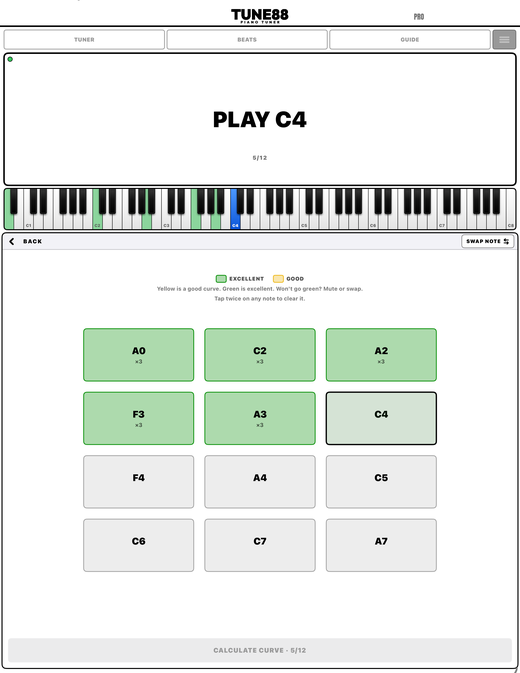
Tap your highest wound string, then arm each note and strike until it goes green. Those thirteen notes cover the whole piano, about two minutes of work; the six temperament notes alone cover the middle for a quick job. Each strike is graded against the physics of real scale designs: implausible reads go yellow instead of silently bending the curve, and the SWAP button substitutes a neighbour when a string is dead or wildly false. A wedge mute is all it takes when an open unison will not read cleanly, and muted reads count.
Best practice: firm, even strikes, and let each ring. If a note sits yellow, tap it again to clear its pool and re-strike. Any note can be spot re-measured later without touching the rest.
The curve: styles, temperaments, and how it was trained
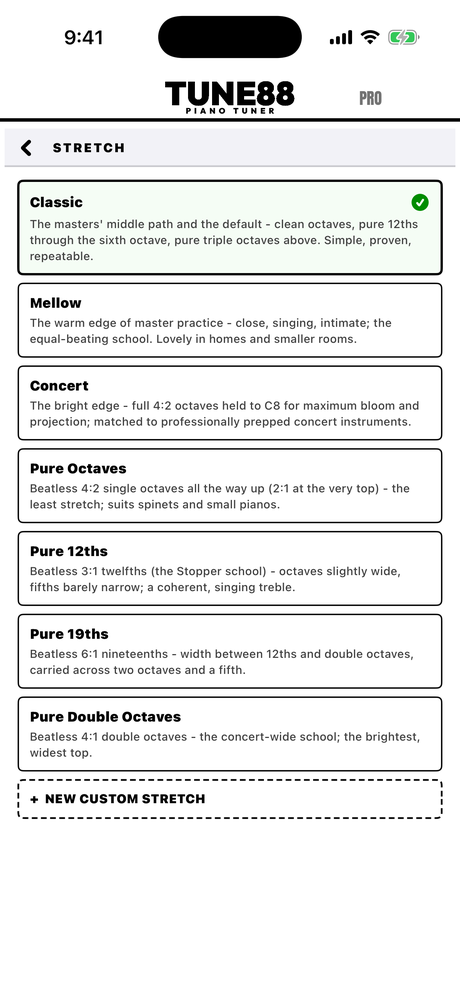
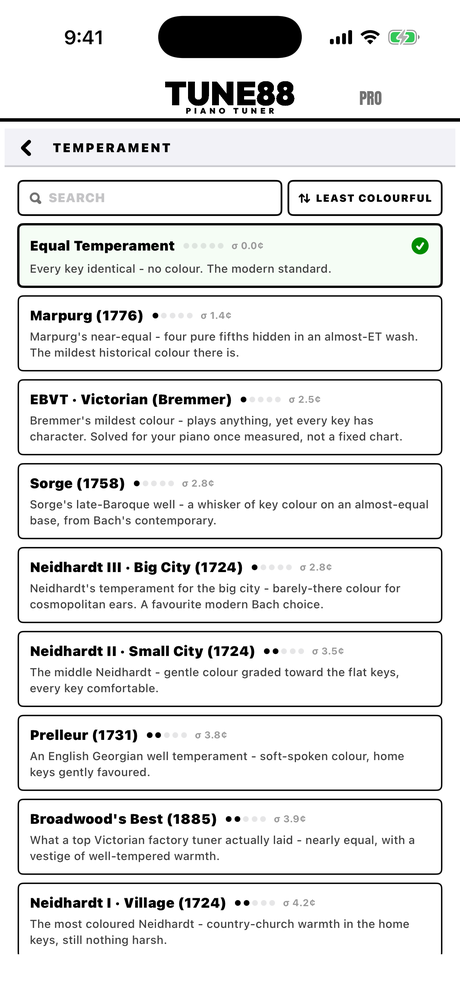
From your measurement the app solves one consistent set of pitches for the whole piano, and every beat target and cents target on every screen derives from that single solution. The rules behind it were reverse-engineered from recordings of master tuners at work: from each session we extracted the tuning the master left and the inharmonicity of the piano he left it on, then derived the relationship between the two. Given only each piano's inharmonicity, the engine lands 1.6 cents RMS from the master's own finished tuning through F3 to C6; another master's tuning copied over misses by 1.9, plain equal temperament by 2.3.
Among the tuners in that corpus: a Korea Master Craftsman No. 1, a Chopin Competition concert tuner who tuned for Richter and Michelangeli, a Steinway-trained technician recorded across three different instruments, and a Steinway technician. Seven recorded sessions between them, note by note. They do not all agree with each other, and where they disagree is where the stretch styles came from.
What the style actually moves. The stretch style is a treble control, and it is worth being blunt about that. On a measured upright it changes the bass by nothing at all, the bearing F3–A4 by under a third of a cent, the treble by a few cents, and the top octave by tens of cents. If you want to move the middle of the piano, that is the temperament, not the style. Classic is the middle of master practice and the default; Mellow and Concert are its warm and bright edges; the pure schools (octaves, 12ths, 19ths, double octaves) follow each school's beatless rule; custom blends solve exactly like the built-ins.
Temperaments work the same way: equal or historical, the offsets are solved into your piano's curve, not pasted from a chart. Your own custom temperaments slot in beside the book.
Pitch raise
The overpull ladder is calculated from the measure before you strike a note: a dashed target line stands above the curve on every note, and a dashed overpull curve rides over the stretch strip so you can see the whole raise in advance. Strike unmuted; the flat unison reads as one pack and you pull one string at a time onto the target. The ONE-STRING OVERPULL option compensates for the strings you have not pulled yet, the fastest way through a big raise. Severe raises get a second, lighter pass; FINISH hands you straight to fine tuning.
Guided sequences
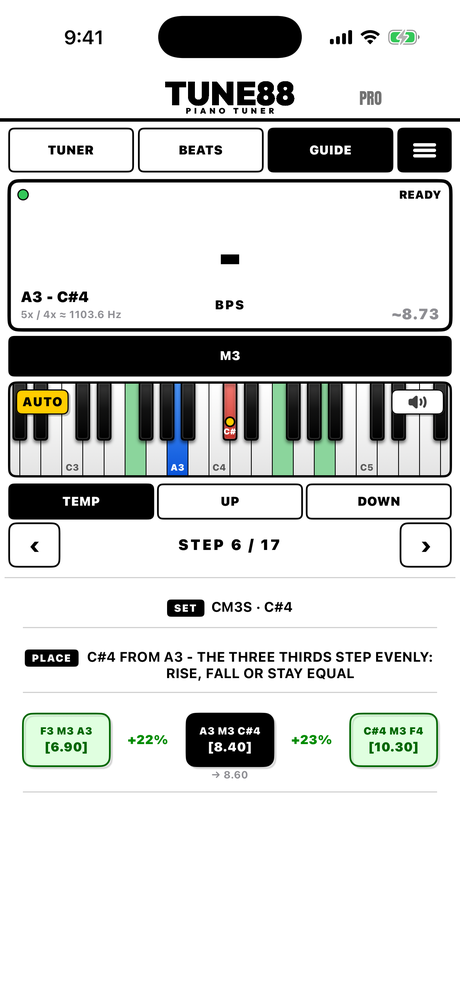
Pick Defebaugh's F to F, Potter's bearing, or Bill Bremmer's Marpurg sequence and the GUIDE tab walks you through it step by step. Each step names the note to set and the checks that prove it, and the detector reads those check intervals live, so the evidence for every step is a measured beat speed, not a feeling. The star markers on the roll show the step's notes.
Theory, ear school and LISTEN
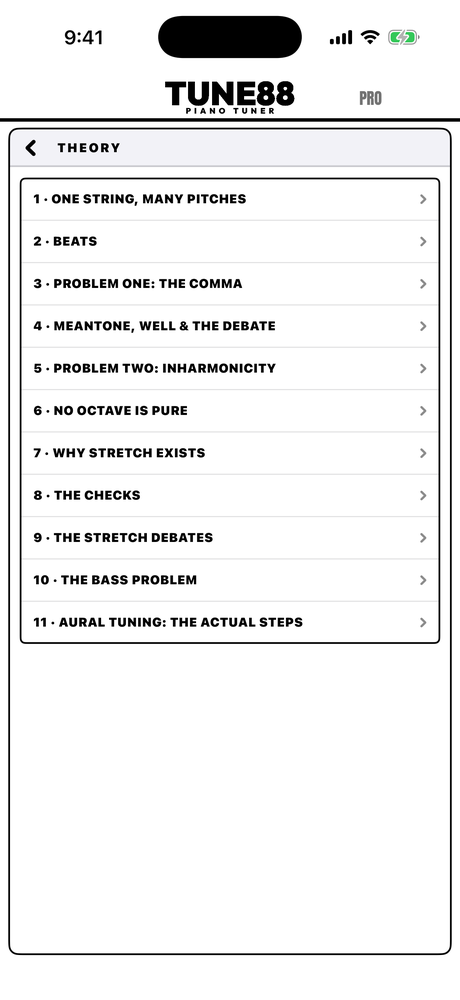
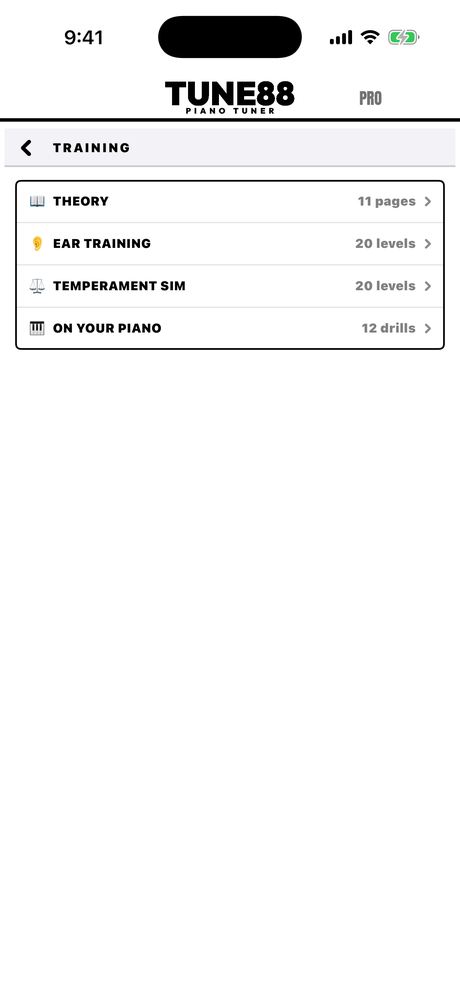
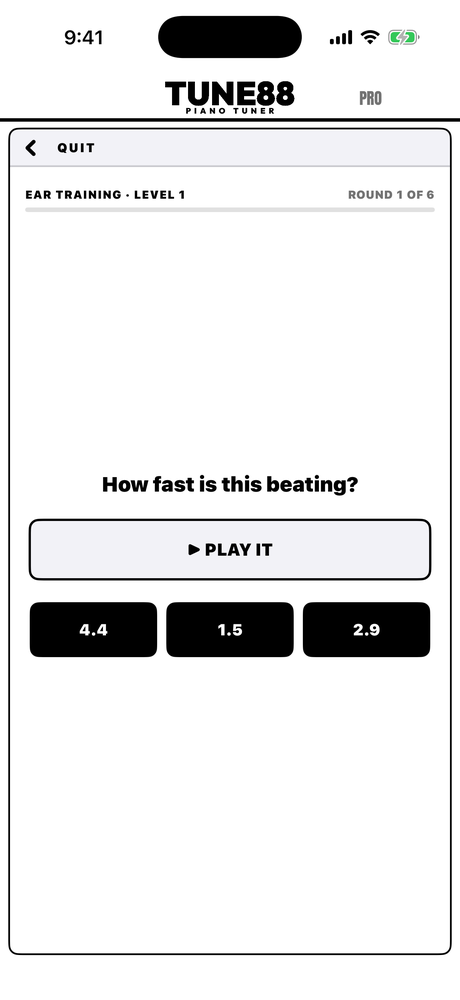
The training wing has three rooms: THEORY, eleven chapters from partials to temperament from first principles; EAR TRAINING, 20 levels where two beats play and you call the faster one, narrowing from ±60% to ±1.6%; and a TEMPERAMENT SIM to hear intervals at chosen rates. The LISTEN toggle isolates the beating partials of whatever you play into your headphones, so the beats you are learning to hear get loud while you learn them.
Most of the school is free. Every theory page, the whole twenty-level ear-training ladder and the temperament simulator as far as THE WINDOW stay unlocked when the trial ends, on any install, forever. The rule is that anything which teaches you without your piano is free; the later simulator levels are Pro.
Reports and tuning files
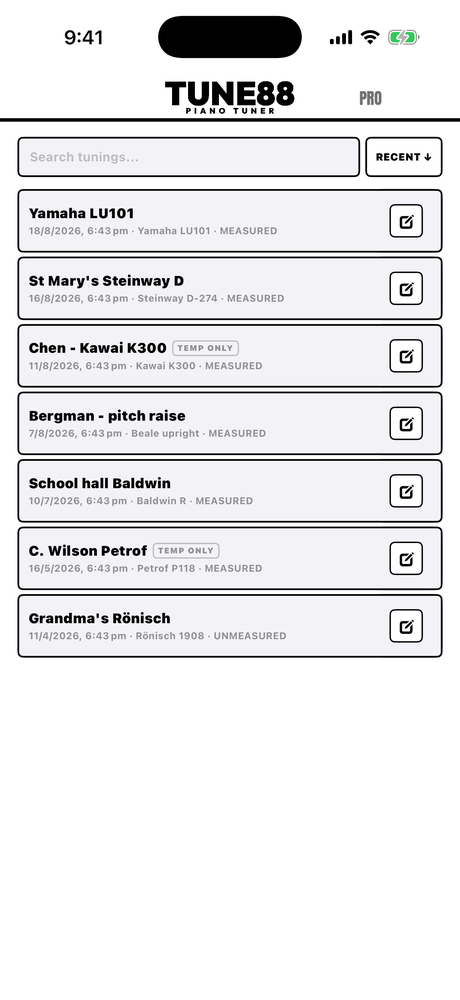
Every job saves as a file: client, make and model, notes, the full measurement, the logged intervals and the tuned-note progress. The LOAD TUNING list shows each piano's state at a glance, with search and newest-first sorting. Reopening a file rebuilds its exact curve, so the next visit to that piano starts where the last one ended, no re-measuring. The TUNING REPORT prints the temperament zone note by note with a quality score, client-ready; the diagnostic report is the deeper version for your own records.
Where your files actually live. Every tuning is its own file on your phone, in the Files app under On My iPhone → Tune88. That means three things. They are included in your iPhone's iCloud backup, so a lost or replaced phone does not cost you your customer history. You can AirDrop one to another device or to a colleague and they open it straight into their own copy of the app. And you can copy the whole folder anywhere you like as an archive. Nothing is locked in an account, because there is no account.
The rest of the toolbox
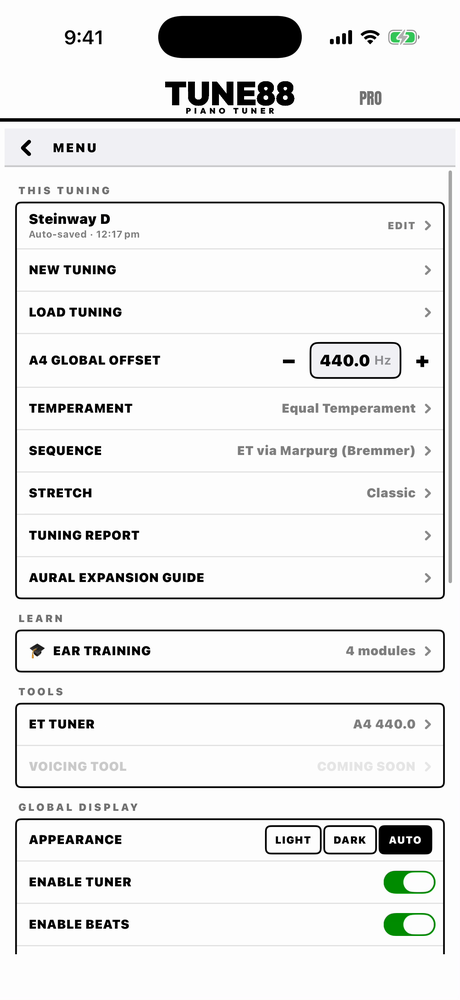
ET tuner: a plain equal-temperament tuner for when that is all the job needs. Noisy venues: noise reduction is always on, with no setting to remember. Landscape: turn the phone sideways for all 88 keys and the whole bench at once, and tap either main window to flip between beats and pitch. Appearance: light, dark, or follow the system.
Honest limits and troubleshooting
Every tuning app has edges and most pages like this one do not tell you where they are. Here are Tune88's, plainly, with what to do at each.
Unisons and stability are not numbers, and no app sets them. Whether a tuning sounds good and whether it is still there next month come down to hammer technique, how you set the pin, and how you equalise the string either side of the bridge. Those are mechanical skills built over years. No electronic tuner does any of it, this one included. That is the whole reason skilled technicians exist, and why someone off the street with a tuning app does not replace one. What this app does is make the measurable part exact so your hands are free for the part that is not.
An out-of-tune unison beats you before the interval does. If the strings of a note disagree by more than a couple of cents, their own beating swamps the interval you are trying to read. That is not a software limit, it is what is in the air. A wedge mute takes ten seconds and fixes it, and it is why beat speeds read best on a muted string.
Beat speeds read best through the middle of the piano. That is where a tuning is decided and where every book's beat table lives. Good tuners hear beats far outside it, right down into the bass, and so can the app when the strike is clean and the room is quiet. But out at the extremes the partials are crowded at one end and gone in half a second at the other, so a reading takes more care and sometimes will not come at all. When it cannot get a clean number, it says so instead of inventing one.
Nobody measures inharmonicity honestly at the very top of the piano. Up there the partials you would need are past where the string sustains. Every electronic tuner on the market, the expensive ones included, stops measuring at some point and starts extrapolating a trend. So does this one, above A7. That is standard practice and it works, but it is an estimate and you should know it is one.
QUIET means quiet. Slow fourths and fifths near the temperament are often below a countable beat. The app says QUIET rather than inventing a number, and still tells you which side of the target you are on.
False beats are flagged, not papered over. A string that wobbles on its own gets called out and the read shows the wobble-averaged centre. On a bad one, tune the note by its octave and move on, exactly as you would by ear.
The seven intervals that matter auto-detect. Minor thirds, major thirds, fourths, fifths, sixths, tenths and seventeenths are identified from the strike itself. Those are the rapidly beating intervals a tuning is judged by, plus the fourths and fifths you keep quiet, and between them they cover the whole job. Octaves, twelfths, double octaves and nineteenths are there as a bonus, but have to be selected by hand: an octave shares too many partials with its neighbours for a detector to call it apart from them reliably, so the app asks rather than guesses.
If an interval will not auto-detect, arm it yourself: tap the lower note on the roll and the detector stops guessing. AUTO comes back with one tap on its pill.
Very loud rooms: if the mic dot is red the room is clipping the phone, and no app reads through that. Move the phone into the piano.
What it is not. It does not diagnose regulation, voicing faults or a cracked bridge. It will not tell you a piano is not worth tuning. And it cannot make a badly strung piano hold a temperament: if the pin torque is gone, the numbers were never the problem.
Privacy and proof
Everything runs on the phone: no account, no tracking, no servers, and your audio never leaves the device. Before any release ships, the detector must read the same 468 recorded piano strikes identically, three runs in a row, and the stretch engine is re-checked against the master tunings it was derived from.
14-day full free trial, once per Apple ID · US$199 once · no subscription
OVERVIEW · ALL FEATURES · TRY FREE / BUY · CONTACT / UPDATES · PRIVACY
Tune88 · Sydney, Australia · danielvicary@outlook.com
This site was made by a piano tuner, not a web designer. Last updated September 2026.